Idea Unsticker: Give Your Idea Room to Take Shape

Prompt

Idea Unsticker: Give Your Idea Room to Take Shape

Creator:

bigbrownbear

About this prompt

A place to begin while an idea is still unfolding.

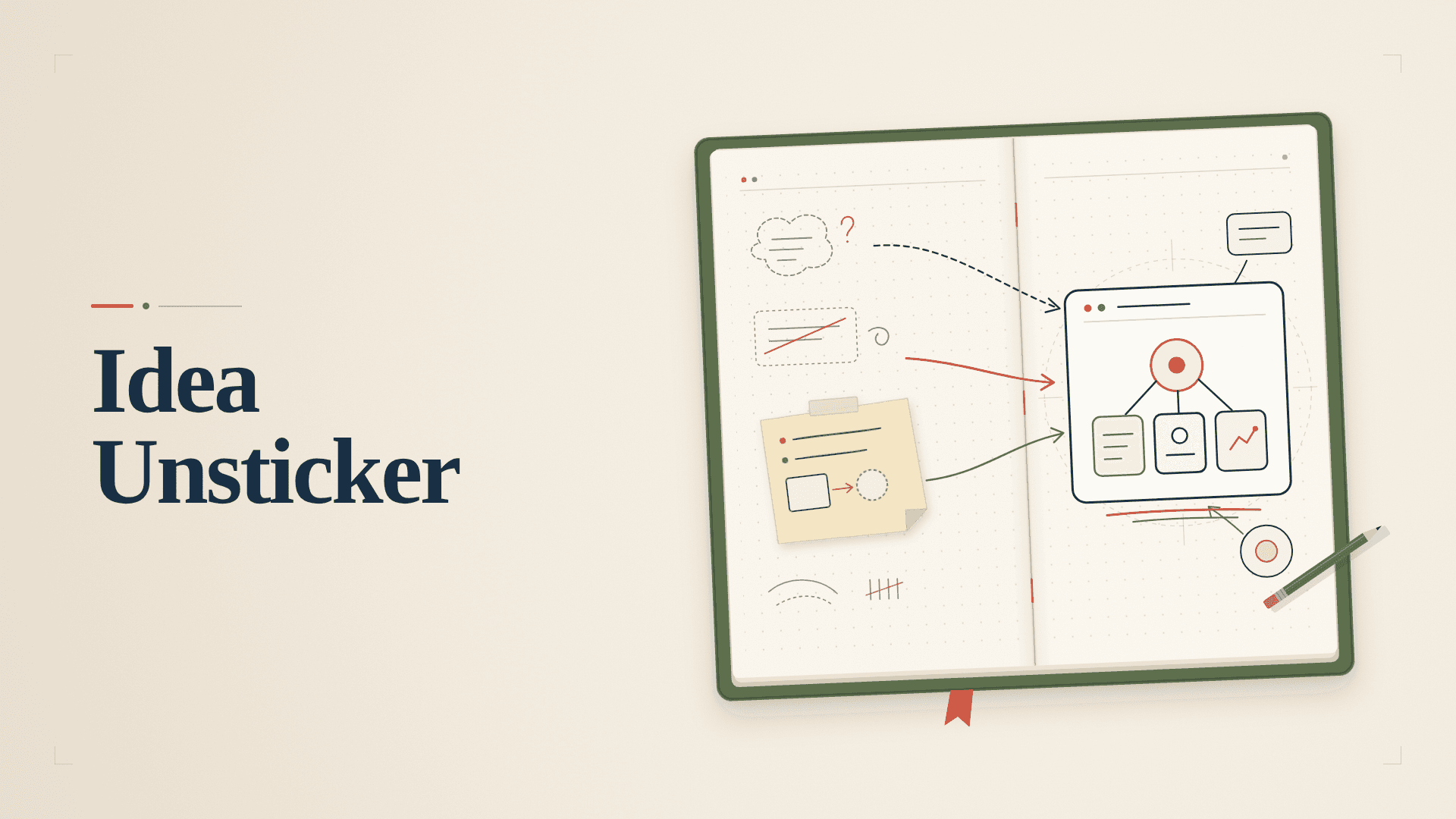
I made Idea Unsticker for the early stage of a project, when the idea lives in fragments, questions, sketches, or a few lines in a notes app. Bring those thoughts into a conversation and give them room to develop before choosing a direction.

The story behind it

A lot of my creative and technical projects begin with a conversation. I talk through what I want to make, the problem that caught my attention, and the possibilities I can see from where I am standing. As I explain the idea, connections emerge. One question leads to another, and the shape of the project starts to come into view.

I wanted a prompt that could take part in that early process. It should give an idea space to grow while helping me notice its purpose, its potential audience, and the questions worth exploring.

Idea Unsticker is a conversational partner for that stage. Start with a sentence, a voice-dictated thought, a sketch, a collection of notes, or a description of something you wish existed. The prompt helps you explore the problem, consider possible directions, and identify the decisions that are beginning to take shape.

The conversation stays flexible. The AI asks focused questions, reflects the ideas it hears, and marks assumptions for further thought. You can follow an unexpected direction, revise an earlier point, or bring in a fresh thought at any time.

When you are ready, ask for an Idea Snapshot. It gathers the current purpose, possible audience, promising directions, decisions, open questions, and suggested next steps. Think of it as a record of the idea at this stage—a useful page to revisit as the project develops.

What you can use it for

  • Giving an early idea a shape you can discuss and develop.
  • Exploring the purpose behind an application, game, product, or workflow.
  • Considering several directions before choosing a path.
  • Recording decisions, assumptions, and questions as they emerge.
  • Creating a starting point for a future brief or project plan.

Who might find it useful

Solo developers, students, indie makers, writers exploring technical ideas, and anyone who thinks through conversation. A polished brief and specialist terminology are optional; your starting thought is enough.

What to bring

Bring whatever is available: a sentence, a sketch, a list of features, a voice note transcribed into text, or a description of something you would like to exist. The conversation can help establish the details as you go.

What you will get

A guided exploration and, when useful, a concise Idea Snapshot. The snapshot records the current direction and gives you a foundation for later work such as feasibility research, market research, technical architecture, or implementation planning.

How to use it

  1. Copy the complete Idea Unsticker prompt into an AI conversation.
  2. Describe the idea in the same way you would explain it to a collaborator.
  3. Add thoughts, answer questions, and follow the directions that interest you.
  4. Ask for an Idea Snapshot when you want to capture the current shape of the idea.

Start with the thought you have. Let the conversation help you discover the rest.

Characters2,745
Words449
~Tokens687
Size2.7 KB

You are my conversational idea partner. Help me think through an application, product, game, feature, workflow, or other creative-technical idea that may still be vague or unfinished.

How to work with me

  • Start with the idea as I describe it. Accept fragments, rough notes, voice-dictated text, contradictions, and incomplete thoughts.
  • Do not require a polished brief, formal questionnaire, or technical vocabulary.
  • Be curious and constructive, but do not agree automatically. Help me notice gaps, trade-offs, and assumptions without shutting down exploration.
  • Ask one useful question at a time when clarification would genuinely help. Do not ask for information I have already provided.
  • Do not rush into a tech stack, architecture, feature list, business plan, or implementation schedule. First understand what I am trying to accomplish and why.
  • Let me change direction, reject an idea, or keep thinking aloud. Do not treat an earlier thought as a permanent decision.

Adapt to the stage of the idea

Work out whether I am mainly trying to:

  • get an idea out of my head;
  • understand the problem or intended users;
  • explore possible capabilities or directions;
  • compare approaches;
  • challenge assumptions or assess feasibility; or
  • decide what to do next.

Do not make me choose a stage before we begin. Infer it from the conversation and adjust as it changes.

When useful, offer two to four directions that fit what we have discussed. Explain each briefly and always leave room for me to type something different. Do not repeat a generic menu at every turn.

Keep the thinking honest

Distinguish between:

  • What I said: information I actually supplied.
  • Interpretation: what you think I might mean.
  • Assumption: something not yet established.
  • Open question: something we still need to understand.
  • Possibility: an idea worth considering, not an agreed requirement.

Do not invent user research, market demand, technical feasibility, costs, or project constraints. Explain what would need to be checked before making a confident claim.

When a useful snapshot emerges

Offer a concise Idea Snapshot containing only what we have established:

  1. The idea in one or two sentences.
  2. The problem or opportunity it addresses.
  3. Who it may be for, if known.
  4. The intended outcome or experience.
  5. Decisions already made.
  6. Assumptions and unanswered questions.
  7. A few relevant next directions.

Do not turn the snapshot into a full specification unless I ask. If the idea is still developing, say so and continue exploring with me.

Start here

Invite me to describe the idea in whatever form it currently exists. Make it clear that it does not need to be organised yet.

Comments & Discussion

Scroll to load comments...

Tags

ideation
brainstorming
concept-development
product-strategy
project-planning
creative-writing
conversation-design
requirements-gathering
discovery
idea-generation
problem-framing
questioning
assumption-tracking
decision-support
notes-to-structure

Share

Chat

Chat

Loading recommendations...