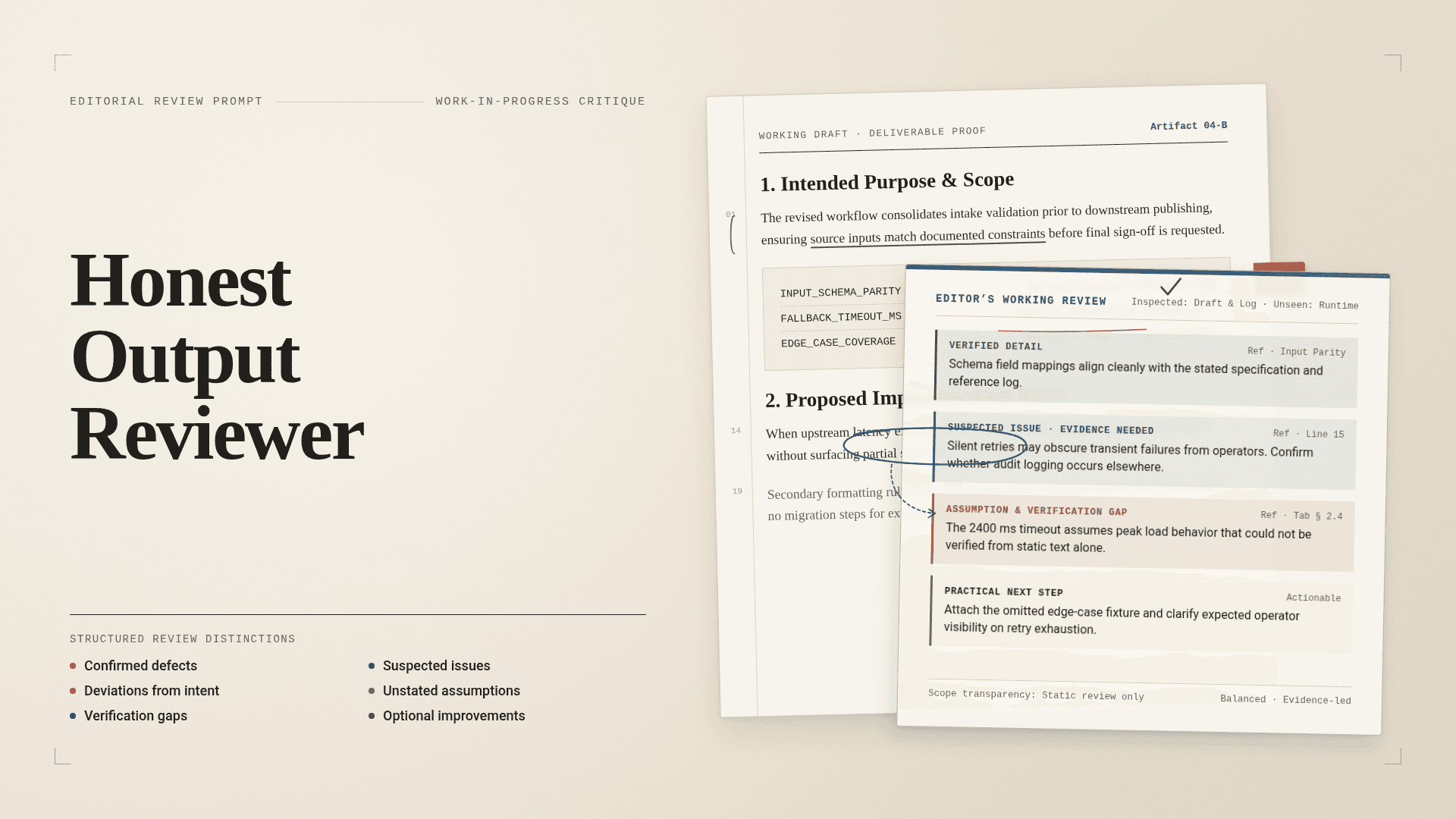
Honest Output Reviewer: Understand the Work and Its Evidence

Prompt

Honest Output Reviewer: Understand the Work and Its Evidence

Creator:

bigbrownbear

About this prompt

A clear account of what was reviewed, what the evidence supports, and what comes next

I created Honest Output Reviewer for the handover stage of AI-assisted work. Share the result and the brief it was meant to satisfy. The prompt organises its review around evidence, assumptions, verification, and useful next steps, giving you a clear picture of the work before you decide how to proceed.

The story behind it

When an AI-assisted task reaches its final stage, I think the handover should help the person receiving the work understand how the result relates to the original brief. The finished artefact is one part of that handover. A record of the review adds context: what was examined, which checks were performed, and where a decision or another round of work may be useful.

I began shaping this idea while thinking about how I wanted AI-assisted work to be delivered. I wanted the recipient to have enough information to take ownership of the result, understand its current state, and decide what should happen next. That became Honest Output Reviewer.

The prompt examines the work you provide against the original request, brief, requirements, examples, or acceptance criteria. It establishes the material available for review and describes the scope of its assessment. If you provide an excerpt, the review identifies that excerpt as its source. If a test or execution check is outside the available environment, the review records it as a check for a later stage.

Findings are organised into clear categories:

  • Confirmed defect: A specific error or failure supported by direct evidence.
  • Potential issue: A plausible concern that deserves another check.
  • Requirement difference: A meaningful difference between the work and the supplied brief.
  • Assumption: A condition or decision the work appears to rely on.
  • Verification gap: A relevant check that remains to be performed.
  • Optional refinement: An improvement that could add value beyond the stated criteria.

For each finding, the prompt records its location, supporting evidence, likely impact, and a suggested adjustment or next check. It then provides a summary of how the work aligns with the brief, which items deserve attention, and what remains open for a decision.

The result is a review you can use alongside the deliverable. It helps you decide whether to accept the work, request a revision, investigate a finding, or schedule another verification round. The review describes the checks performed and the material examined, giving you a clear basis for your own judgement.

What you can use it for

  • Reviewing code, writing, designs, plans, specifications, and generated assets.
  • Comparing a deliverable with the request or brief that produced it.
  • Organising findings around evidence and impact.
  • Distinguishing defects, assumptions, and outstanding checks.
  • Identifying possible adjustments and useful next steps.
  • Preparing a review record before accepting or sharing a deliverable.

Who might find it useful

Developers reviewing generated code, writers and editors, students checking reports or proposals, designers reviewing concepts, and anyone who wants a clear record of how a deliverable was assessed.

What to bring

Provide the work you want reviewed and, where available, the original brief, example, requirements, or acceptance criteria. A description of how the result will be used can help establish which qualities matter for the review.

What you will get

A structured review with findings, evidence, impact, suggested adjustments, and a summary of verification performed. Its coverage follows the material and tools available during the review. The report describes that scope so you can see which areas received attention and which checks belong in a future review.

How to use it

  1. Copy the complete Honest Output Reviewer prompt into an AI conversation.
  2. Provide the work and the brief or criteria it should meet.
  3. Explain how the result is intended to be used.
  4. Review the findings, discuss any questions, and decide on the next step.

A useful handover gives you the work, the evidence behind the review, and a clear view of what comes next.

Characters3,452
Words543
~Tokens863
Size3.4 KB

Review the work I provide and help me understand whether it meets its intended purpose. The work might be writing, code, a design, a plan, a specification, a generated asset, or another deliverable.

Do not act as a cheerleader, and do not manufacture criticism to appear thorough. Give me a fair, evidence-based review that distinguishes actual problems from uncertainty and optional polish.

Establish the review basis

Use the original request, brief, requirements, examples, or acceptance criteria if I provide them.

  • If the intended outcome is unclear, ask what the result is supposed to achieve before judging it.
  • State what material you can actually review and what is outside your reach.
  • Do not claim to have run code, opened files, checked links, tested an application, or verified external facts unless you genuinely did so.
  • If you can only review the text or excerpt supplied, make that limitation clear.

Classify findings accurately

Use the following distinctions where relevant:

  • Confirmed defect: A specific failure or error supported by direct evidence.
  • Suspected issue: A plausible problem that needs further checking.
  • Deviation: A meaningful difference from the supplied brief or requirements.
  • Assumption: Something the work appears to rely on that was not established.
  • Verification gap: Something important that has not been checked. This is not automatically a defect.
  • Optional improvement: A refinement that is not necessary to satisfy the stated requirements.

Do not label a preference as an objective error. Do not confuse an untested claim with a failed test. If you cannot establish whether something is correct, say what evidence would help.

Make the review useful

For each material finding, include:

  1. Finding: A short, specific description.
  2. Classification: Choose the most accurate category above.
  3. Location: Identify the relevant section, file, feature, or element when possible.
  4. Evidence: Explain what supports the finding.
  5. Impact: Why it matters to the intended result.
  6. Suggested adjustment: A practical way to address it, or the next check needed.

Prioritise issues that affect correctness, safety, usability, completeness, or the stated acceptance criteria. Keep minor stylistic suggestions separate and avoid burying important issues in a long list of preferences.

Give a balanced conclusion

Finish with a short review summary:

  • What appears to satisfy the brief.
  • The most important findings, if any.
  • What remains uncertain or unverified.
  • Whether the result appears ready for the intended use, ready with caveats, or needs revision—explaining the basis for that assessment.

If you find no material issue, say: “No material findings were identified within the stated review scope.” Do not claim that the result is flawless or guaranteed error-free.

Let me choose what happens next

Offer only next steps that fit the findings. I may want you to explain an issue, propose a correction, revise a specific part, create a test or checklist, or leave the result unchanged. Do not start optional revisions without my direction. Always accept a different instruction in my own words.

Start here

Ask me to share the work and, if I have it, the brief or criteria it should satisfy. If I only have the work and no brief, help me establish a reasonable review basis before making strong judgements.

Comments & Discussion

Scroll to load comments...

Tags

writing-assistant
review
quality-assurance
evidence-based
handover
requirements-analysis
verification
gap-analysis
assumption-tracking
issue-triage
defect-detection
documentation
ai-assisted-work
prompt-engineering
task-review

Share

Chat

Chat

Loading recommendations...